Running today
Workplace safety analytics
We read the incident and near-miss reports a site already keeps and measure where they are concentrating: by cause, work area and site, and how that mix changes across the years in the file.
Workplace safety software
See recurring patterns by site and work area.
“Cut to the left thumb from a deburring blade while trimming a housing seam.”
Matched terms: “Cut” · “blade”
The report and the rule stay attached to every finding.
Try the demonstrationTry it here
Explore the sample records, change a filter and watch the counts and supporting reports change together.
Interactive example using sample data. Open a category to inspect its reports.
Explore the report
30 sample incident reports
Where
When
28 reports in view: 24 placed in a category, 4 for your review; 2 excluded as duplicates.
Cut to the left thumb from a deburring blade while trimming a housing seam.
Rule C1: term “cut” found “Cut”; term “blade” found “blade”.
Hand pinched at the nip point of the label applicator, then cut on the blade guard.
Rule C1: term “cut” found “cut”; term “blade” found “blade”. Also counted in “Caught or pinched” (rule O1).
Laceration to the forearm from a sharp edge on a guard panel.
Rule C1: term “lacerat*” found “Laceration”; term “sharp edge” found “sharp edge”.
A strapping band snapped back and cut a knuckle.
Rule C1: term “cut” found “cut”.
Cut on the palm from a burr on a finished weldment.
Rule C1: term “cut” found “Cut”.
Showing 5 of 5 counted.
Operator’s glove caught between the feed rollers while clearing a misfeed.
Rule C2: term “caught” found “caught”.
Finger pinched in the press guard hinge during a die change.
Rule C2: term “pinch*” found “pinched”.
Sleeve caught on the conveyor return roller; the operator pulled free, no injury.
Rule C2: term “caught” found “caught”.
Hand pinched at the nip point of the label applicator, then cut on the blade guard.
Rule C2: term “pinch*” found “pinched”; term “nip point” found “nip point”. Also counted in “Cuts and lacerations” (rule O1).
Thumb caught in the stacker gate as it closed.
Rule C2: term “caught” found “caught”.
Fingertip pinched between the mould halves while clearing a jam.
Rule C2: term “pinch*” found “pinched”.
Glove caught on a drill chuck; the operator stopped the drill, unhurt.
Rule C2: term “caught” found “caught”.
Wrist caught under the clamp bar while loading a part.
Rule C2: term “caught” found “caught”.
Showing 8 of 8 counted.
Carton dropped from the top shelf of the rack and landed beside a picker.
Rule C3: term “dropped” found “dropped”.
Wrench fell from the mezzanine and struck the floor near a fitter.
Rule C3: term “struck” found “struck”; term “fell from” found “fell from”.
Load shifted on the forklift and a box dropped into the walkway.
Rule C3: term “dropped” found “dropped”.
Tote fell from the upper conveyor and struck the guard rail.
Rule C3: term “struck” found “struck”; term “fell from” found “fell from”.
Pallet dropped from the dock plate, no one nearby.
Rule C3: term “dropped” found “dropped”.
Showing 5 of 5 counted.
Slipped on hydraulic oil near pump 3 and bruised an elbow.
Rule C4: term “slip*” found “Slipped”.
Tripped over a pallet corner in aisle 4.
Rule C4: term “trip*” found “Tripped”.
Wet floor by the wash station; an operator slipped but kept their balance.
Rule C4: term “slip*” found “slipped”; term “wet floor” found “Wet floor”.
Fitter tripped on a hose and strained a knee.
Rule C4: term “trip*” found “tripped”. Also counted in “Strains from lifting” (rule O1).
Tripped over a strapping coil left in the lane.
Rule C4: term “trip*” found “Tripped”.
Showing 5 of 5 counted.
Back strain after lifting a coil of wire from floor level.
Rule C5: term “strain*” found “strain”; term “lifting” found “lifting”.
Strain to the wrist while lifting a motor onto the bench.
Rule C5: term “strain*” found “Strain”; term “lifting” found “lifting”.
Fitter tripped on a hose and strained a knee.
Rule C5: term “strain*” found “strained”. Also counted in “Slips and trips” (rule O1).
Showing 3 of 3 counted.
Description too short to read (rule U1): 1
Sore shoulder.
No category term found (rule U2): 3
Felt dizzy near the oven exit and went home early.
Cleanup after a spill; back sore the next day.
Heat rash reported after a long shift at the oven.
Showing 4 of 4.
Rule X1: a second entry of DEMO-06. Left out of every count.
Rule X1: a second entry of DEMO-21. Left out of every count.
The category counts add to 26, not 24: DEMO-10 and DEMO-23 each match two categories and are counted in both (rule O1).
Grouping rules for this interactive example.
Start with the incident and near-miss reports a site already keeps, read in the browser.
Open a category count to see the reports behind it.
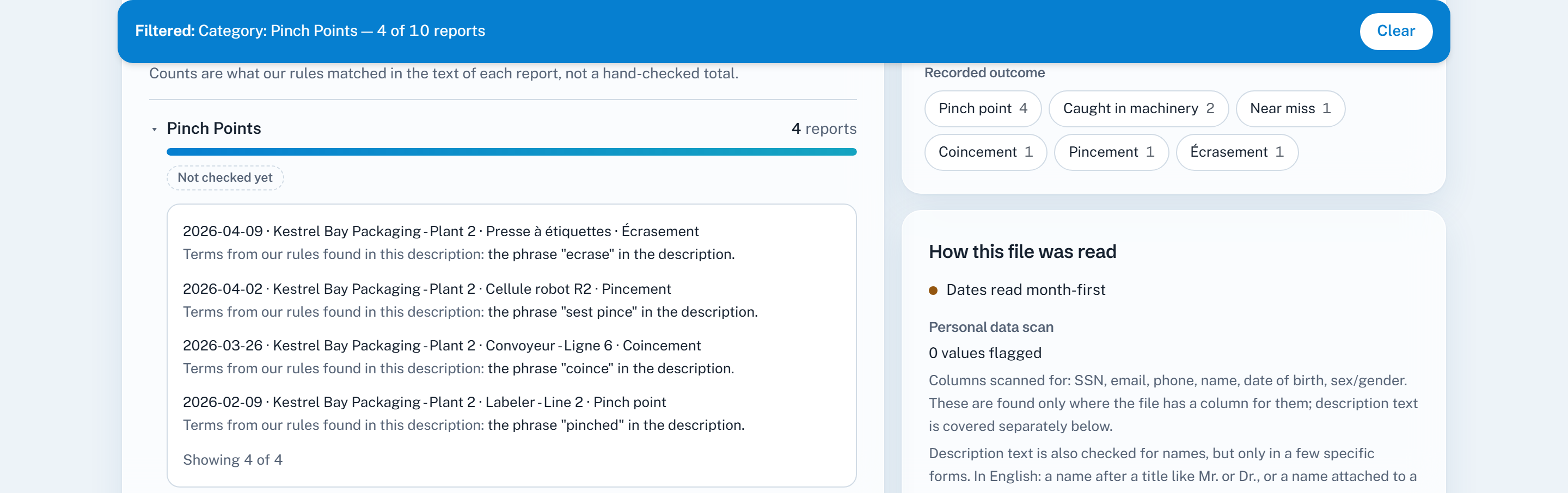
See the rule terms found in each report, and what the rules could not place.
One report, with the details behind it.
Bring incident and near-miss reports together, group them by written rules and explore where they concentrate.

One category and the number of reports counted in it.
Its date, plant, line and recorded outcome.
Under each report, the words from our rules found in its description.
The console’s own mark of whether this count has been checked.
Running today
We read the incident and near-miss reports a site already keeps and measure where they are concentrating: by cause, work area and site, and how that mix changes across the years in the file.
In development — working prototype
A record in which each automated scan, human approval and correction is signed and linked to the one before it, so a missing or altered entry is detectable. It is not yet part of a shipped product.
Plumbline Systems is a small, woman-owned business based in New Jersey.
We build focused software for manufacturing safety teams and for businesses that want software built around how they work.
Tell us what you need to examine.
A 30-minute walkthrough. No commitment and no files needed.
Prefer email or the phone? Write to info@plumbline.systems or call (609) 232-2289.
Plumbline Safety Console · Synthetic data